Against “Against Taste”
Originally published on X.
Taste did not suddenly arrive. Every few years the word comes back into fashion and starts carrying more weight than it should. But taste itself is simple. It is knowing what is good.
That sounds abstract, but in practice it isn’t. The simplest test I use is this: could I serve a better sushi dinner than Jiro? I am almost certain I could not. No amount of AI, no amount of reading, no perfectly optimized workflow would close that gap. I would still miss something. The feel of the rice. The temperature. The sequencing. The sourcing. The decades of palate refinement. The thousands of small decisions that compound into an experience. The gap isn’t information. It’s judgment. Taste is judgment built through experience under constraint. You cannot shortcut it by having access to more tools.
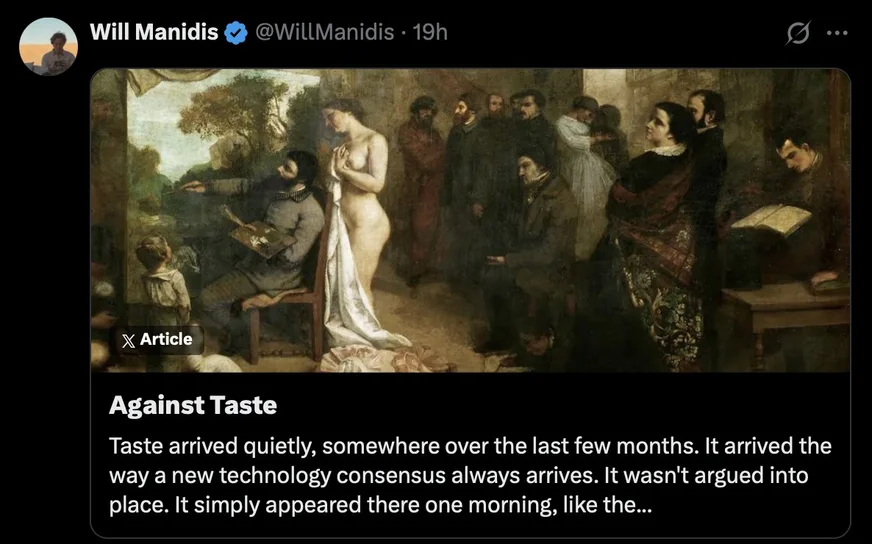
There’s an argument that what we now call taste is just consumption. That when patronage disappeared, all that remained was selection. That taste is what you call the patron’s function after the patron leaves the room. I think that collapses different roles into one.
Patronage is a structure. It’s a way of financing and organizing work. It can produce greatness, but it can just as easily produce mediocrity. The presence of capital and friction does not guarantee quality. It guarantees resources. One reason why we see the great works of patronage is because great works were preserved and valued over time. The vanity and mediocrity disappeared.
But to me taste is something else. It’s the internal compass that lets someone recognize quality in the first place and strive towards it.
Michelangelo had taste. Julius II had enough taste to recognize when to push and when to allow something bigger to unfold. But taste isn’t passive selection at the end of a process. It is informed judgment throughout the process.
Where I agree is that pure consumption is empty. Filling an apartment with perfectly “tasteful” furniture is not necessary taste, it might be just vanity. Lot of modern American archifure is this way where it meant to impress in vain way and not to have some kind of tasteful quality in it. The quality without the name.
It also helps to separate art and design. Art expresses. What counts as good is often socially decided. Critics, institutions, and context shape interpretation. Sometimes the meaning has to be constructed because there is no functional test. At certain point the artist will matter more than the art piece. Good taste in art can slip in to validating itself.
Product design operates differently since it has external , more or less objective, validators users or customers. A car has to work. A hospital has to function. Software has to perform reliably and scale. There are constraints and feedback loops. Users verify whether it succeeds.
Taste in design is not just solving the problem, but solving it elegantly. Elegance is coherence, restraint, proportion, clarity. It is the difference between something that technically works and something that feels great.
Most of that work is invisible. It lives in system architecture, in how errors are handled, in performance margins, in materials that age well, in decisions about maintenance and scale. This has lived as long as humans have been creating a building. Designing and building a barn might exercise great taste and judgement.
The non-builders often see taste is about selection, curation, higher purpose. Artists talk about cheap turpentine for a reason. Craft lives in materials, constraints and in their daily work. Serious practitioners argue about details. Taste is exercised inside the work, not curated at the end.
There is also the fear that in an AI world humans will be reduced to discriminators, judging outputs generated elsewhere. But real taste is not an only a filter. It shapes direction before inputs and before outputs are finalized. It sets constraints, defines standards, and rejects entire categories or paths.
The real commentary on here is that Silicon Valley loves their slogans and concepts. Companies love talk about taste when it becomes fashionable, while optimizing for speed, growth, and fundraising. These words are used aesthetic signals but what really matters is the next launch/funding. Under those incentives, there is no real place for taste and talking about it doesn’t mean actually exercising it.
Taste is not the residue of a broken relationship between capital and labor. It is knowing what good looks like, defending that standard, and refining toward it over time. Humans after AI are not just critics. They are definers of quality. They decide what is worth building in the first place and when it is good enough to ship.
That has always been the work of the creator and the moral code. Strive for something good.